Wind Cave National Park
Useful Information


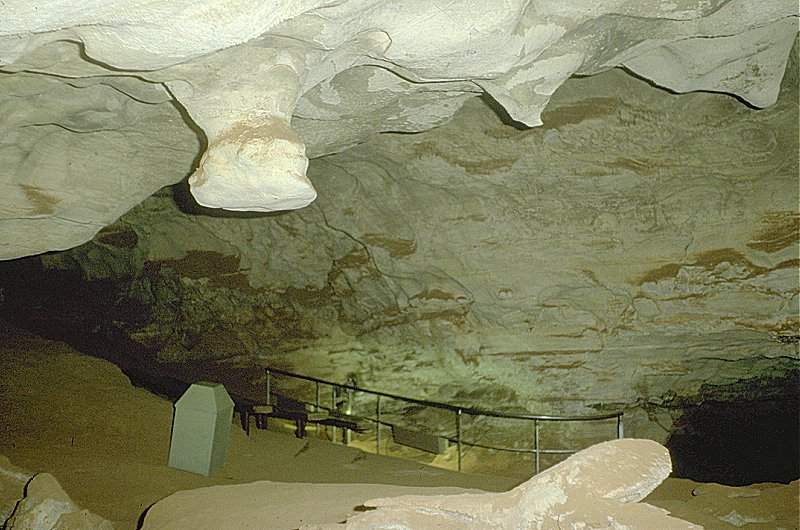
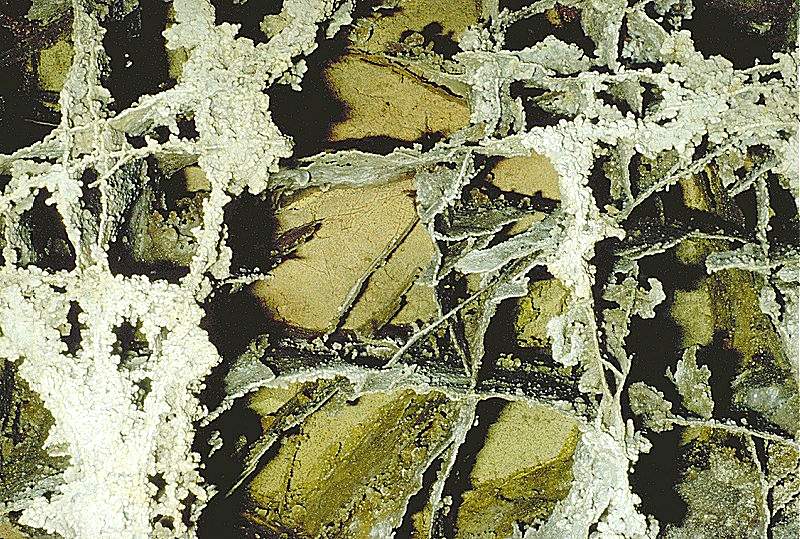
 boxwork is an extremely rare speleothem, but in Wind Cave it is common and really big.
| Location: |
From Rapid City Hwy 79 south 80 km, then west on 385 8 km.
16 km north of Hot Springs, SD, on U.S. Route 385.
Navi: 26611 US Highway 385, Hot Springs, SD 57747 (43.556612, -103.478631) |
| Open: |
JAN to mid-APR daily 8-16:30. Mid-APR to MAY daily 8-17. JUN to mid-AUG daily 8-19. Mid-AUG to mid-SEP daily 8-18. Mid-SEP to SEP daily 8-17. OCT to DEC daily 8-16:30. Closed on Thanksgiving, 25-DEC, 01-JAN. [2021] |
| Fee: |
Garden of Eden Tour: Adults USD 10, Children (6-16) USD 5, Seniors (61+) USD 5, Children (0-5) free. Natural Entrance Tour: Adults USD 12, Children (6-16) USD 6, Seniors (61+) USD 6, Children (0-5) free. Fairgrounds Tour: Adults USD 12, Children (6-16) USD 6, Seniors (61+) USD 6, Children (0-5) free. Candlelight Tour (mid-JUN to mid-AUG): Adults USD 12, Children (8-16) USD 6, Seniors (61+) USD 6, Children under 8 not permited. Wild Cave Tour (mid-JUN to mid-AUG): Adults USD 30, Seniors (61+) USD 15, MinAge=17. [2021] |
| Classification: |
 Karst cave
Wind Cave
Pahasapa Limestone, 350Ma. Karst cave
Wind Cave
Pahasapa Limestone, 350Ma.
|
| Light: |
 LED Lighting LED Lighting
|
| Dimension: | L=248,161 m, VR=194 m, 7th longest of the world.[2021] T=12 °C. |
| Guided tours: |
Candlelight Tour (mid-JUN to mid-AUG): L=1600 m, D=120 min. Fairgrounds Tour: L=800 m, D=90 min, St=450. Garden of Eden Tour: L=400 m, D=45 min, St=150. Natural Entrance Tour: L=800 m, D=90 min, St=450. Wild Cave Tour (mid-JUN to mid-AUG): L=1000 m, D=240 min. All cave tours are ranger-guided and leave from the visitor center. [2021] |
| Photography: | allowed |
| Accessibility: | no |
| Bibliography: |
Rob Kolstad et al. (2001):
Caves of Williams Cañon, History, Exploration, Science, and Conservation 1982-2000
248 pp illus. Good account of Cave of the Winds, Colorado. Nicely illustrated. SB
Jeanne K Hanson (2007): Caves, 142 pp, 16 colour and 30 B&W photos. Chelsea House, New York. |
| Address: | Wind Cave National Park, RR 1, Box 190-WCNP, Hot Springs, SD 57747-9430, Tel. +1-605-745-4600. |
| As far as we know this information was accurate when it was published (see years in brackets), but may have changed since then. Please check rates and details directly with the companies in question if you need more recent info. |
|
History
| 1881 | discovered by the two brothers, Jesse and Tom Bingham, heard a loud whistling noise. |
| 1881 | cave first explored by Charlie Crary. |
| 1884 | first documentation of a cave visit published by the Custer Chronicle. |
| 1887 | length of three miles reported by the Hot Springs Star. |
| 1892 | Wonderful Wind Cave Improvement Company established. |
| 1892 | cave visited by William Jennings Bryan and Governor Lee. |
| 16-AUG-1896 | visited by the geologist
 Luella Agnes Owen,
her theory on cave formation involves geyser activity. Luella Agnes Owen,
her theory on cave formation involves geyser activity.
|
| APR-1902 | first government survey of cave completed. |
| 1902 | bill to establish Wind Cave National Park passes the US Senate and House of Representatives. |
| 09-JAN-1903 | President Theodore Roosevelt signed the bill for Wind Cave to become the seventh national park. |
| 1910 | General Pershing visits cave with pocket aneroid barometer, but guides refuse to believe cave room depths. |
| 1920 | cave visited by Baron Eugen Fersen and his mother, and by Baroness Medem, of Moscow, Russia. |
| 1931 | first electric lighting system installed. |
| 1934 | construction of elevator by the Civilian Conservation Corps (CCC). |
| 1935 | Otis elevator installed, also concrete stairs and iron railings installed to replace wooden ones. |
| 1941 | electric light system repaires. |
| 1947 | elevator fails and is repaired. |
| 1952 | complete repair of elevator. |
| 1959 | second elevator installed. |
| 1980 | fourth lighting system installed. |
| 1988 | cave lighting project, incandescent lights replace fluorescent. |
| 1992 | elevator upgraded. |
| 1996 | "air tight" rooms at both elevator landings. |
| 1998 | new elevators installed over the winter. |
| 14-AUG-2010 | electric light renovated, LED installed. |
Description


Although Native Americans have known about the cave, they never entered through the narrow natural entrance. But they lived sometimes nearby, tipi rings were very found near the entrance. It is unknown what they believed about the cave and its wind.
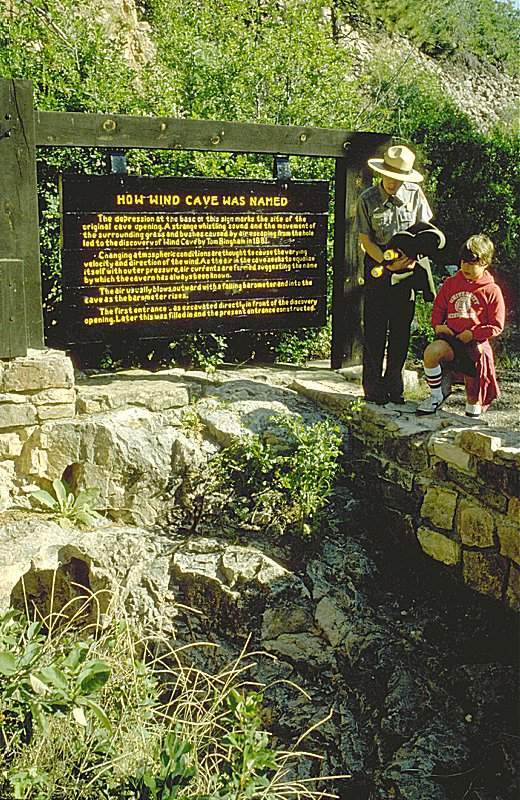
The cave was discovered by white settlers in 1881, when two brothers, Jesse and Tom Bingham, heard a loud whistling noise. The sound led them to a small hole in the ground, the cave's only natural opening. At this time the wind was blowing with such a force out of the hole that it knocked Jesse's hat off. That wind, which gave the cave its name, is created by differences between atmospheric pressures in the cave and outside. If the pressure changes due to the weather, the air inside the cave has still the same pressure, and the wind blows to equalize the air pressure. In other words, if outside is high pressure the wind blows into the cave, if outside is low pressure it blows out. And if the pressure changes fast and the difference is big the wind is strong. This wind is still the same it was at the discovery.
But the first decade of the cave history is dominated by a fight between two parties about the ownership of the cave. In 1889 the South Dakota Mining Co. run by Robert B. Moss established mineral claims on cave area. In the same year J.D. McDonald and his family moved to Hot Springs. He was hired as manager of Wind Cave by South Dakota Mining Co. and was asked to file homestead claim on the land and later deed it to the company. But there was a disagreement between Moss and McDonald. They continued to sue each other until finally in 1900 the court decided that neither has any claim on the cave. In short: without mining no mineeral claim, without homestead no homestead claim. The Secretary of Interior, Hitchcock, states neither party is entitled to the land. As a result the government withdraws 1000 acres of land around cave entrance from mineral or agricultural entry. The bill to establish Wind Cave National Park passes the US Senate and House of Representatives in 1902. In 1903 President Theodore Roosevelt signs the enabling legislation for creating Wind Cave National Park. Wind Cave is the first cave to become a national park in the world.
The start of the formation of Wind Cave was 320 million years ago. At that time parts of the limestone that constitute the upper levels of Wind Cave were being dissolved and first cave passages formed. As ancient ocean levels fluctuated, these passages were filled with sediments. Beneath the ocean, a thick layer of sediments continued to be deposited above that limestone. About 60 million years ago, the forces that uplifted the Rocky Mountains also uplifted the modern Black Hills producing large fractures and cracks in the overlying limestone. Over millions of years, water moving slowly through those cracks dissolved the limestone to produce the complex maze of the cave's passages. Later erosion changed surface drainage patterns that caused subsurface water levels to drop, draining the cave passages. As the modern Wind Cave formed, many of these newer passages intersected the original cave, revealing the red clay and sandstone sediments from 320 million years ago.
The common, well known cave formations, such as stalactites and stalagmites, are uncommon here.
One of the most prominent features in Wind Cave is
boxwork, thin, honeycomb-shaped structures of calcite that protrude from the walls and ceilings.
Nowhere else in the world can such a large display be seen.
The origin is rather simple: cracks in the rock are filled with calcite crystals by ground water.
When the limestone is dissolved by the groundwater the calcite crystals are far more resistant than regular limestone, so the rock is dissolved, while the calcite in the cracks remains as a framework or calcite plates.
Then there is popcorn or bulbous calcite, small protrusions which are formed like little mushrooms, often with stems. They are small but appear in great numbers, forming coral like incrustations. They are sometimes called cave coral.
And finally there is frostwork, thin, white cristal needles which look like frost, hence the name. They are like all formations crystals consisting of CaCO3, but not calcite, they are composed of aragonite, a polymorph of calcite. Sometimes its calcite replaced by aragonite. The long needle-like crystals, situated in clusters which radiate outward from a common base are also called anthodite. Its origin is controversial. One theory is moist, circulating air which contains dissolved calcium carbonate, drifts against rock surfaces and coats them with the delicate crystals. Another is seepage from cave passageways with extremely high evaporation rates. They are found all over the world, but caves with an abundance of frostwork exist only in the Black Hills, at Carlsbad, and a few other locations.
Rather new theories about popcorn and frostwork, as well as helictites, state, that they are formed by biological process not by chemical processes. They are deposited by nano-bacteria which live in the speleothems and use the calcite in the water to build the structures.
You might wonder if after more than 100 years of exploration there is anything new to discover in Wind Cave. Barometric wind studies estimate that approximately 5 percent of the total cave has been discovered. In 1891 Alvin McDonald wrote in a diary of his cave trips: "Have given up the idea of finding the end of Wind Cave." But the better-equipped cavers of today have not given up. They are continuing to push farther and farther, and at the moment the cave has a total length of almost 250 km.
The cave was opened to the public in the early 20th century, the first guides in 1902 are George Stabler, Elmer McDonald, and Peter Paulsen, who are allowed to charge visitors $ 0.50. In 1903 the cave becomes a National Park and the official fee is $0.50. The guided tours are strenuous and take three hours, there are only two tours daily, one at 9 and one at 14. It takes until the 1930 to develop the cave with concrete trails, iron railings, and install electric light. But also new buildings were erected, and en elevator installed. But the elevator had its first breakdown after only two years, the precipitation of moisture on switches and other controls from the cooling of the warm moist air rising through the shaft from the cave caused oxidation. A more or less airtight door was constructed to avoid air circulation. The multitude of infrastructure works ended finally around 1940 with World War II.
A never ending story was the elevator. The first collapsed after only 10 years, the second also. Then a second one was installed due to increasing visitor numbers. Soon after it was again remodeled. When the visitor numbers exploded in the 1950s only 5% of the park visitors could take a cave tour. The sixties were a time of firsts, first experimental spelunking tour, first photographic tours, first candlelight tours. It was also the era with the highest numbers of visitors to date. The largest group ever in 1966 was 210 visitors on single tour.
In 2010 the electric light system was renovated, the light bulbs were replaced by LED lights. This reduced the electricity consumption, and also the bill, by about 80%. The new lighting system was officially inaugurated on the 14th and 15th August 2010 with free tours to the cave.
- See also
 Search Google for "Wind Cave National Park"
 Google Earth Placemark
 Wind Cave National Park - Wikipedia (visited: 26-APR-2021)
 Wind Cave NP, official website (visited: 26-APR-2021)
- Wind Cave NP (visited: 26-APR-2021)
- Wind Cave National Park, United States, South Dakota (visited: 26-APR-2021)
 Index
Index Topics
 Hierarchical
 Countries
 Maps
Maps Search