The Story of the Poacher Leichtweiß
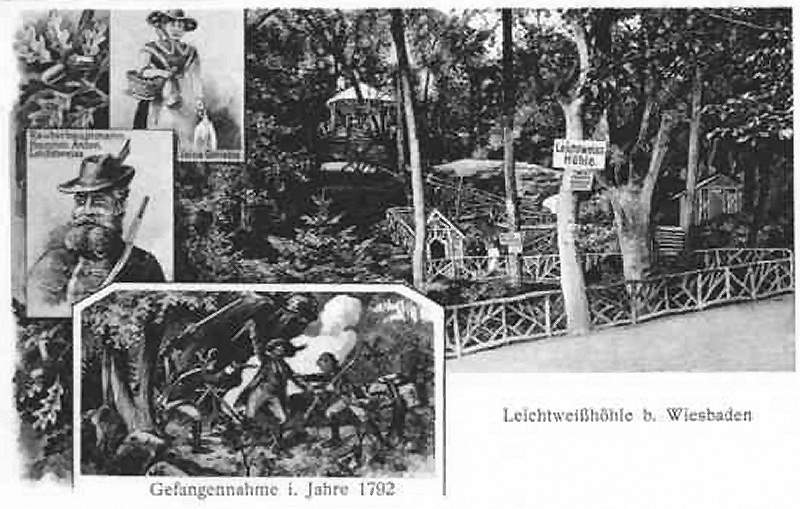
Heinrich Anton Leichtweiß was born on 29-DEC-1723. He lived in Dotzheim and had a bakery there. He was married and had a total of 13 children, but 6 of them died in infancy, quite normal at that time.
Whether he poached for food or for the pleasure of the hunt is not known. But it is certain that he poached and was caught. The authorities first sentenced him to probation. By poaching again, he broke the parole and was now wanted. To avoid prison, he fled into the forest and hid in a cave.
Leichtweiß spent a total of 13 years of his life in this cave, from 1778 to 1791. He enlarged it and created a raised and dry side alcove as a sleeping place, a fireplace over the hearth and an entrance room with seating. The entrance at that time was a hidden hole, certainly not large enough to walk through upright. Whether he continued to make a living from poaching, or whether his family brought him food is not known.
But finally in 1791, a forestry worker became aware of smoke that seemed to be coming from the rock. It was the smoke from Leichtweiß’s cooking fire, which had a smoke outlet through the rock. Now the cave was also quickly discovered and Leichtweiß was arrested. He was sent to prison where he died only two years later, on 12-MAR-1793. This is probably due to the conditions of imprisonment and also explains why he originally fled; the sentence was effectively a death sentence.
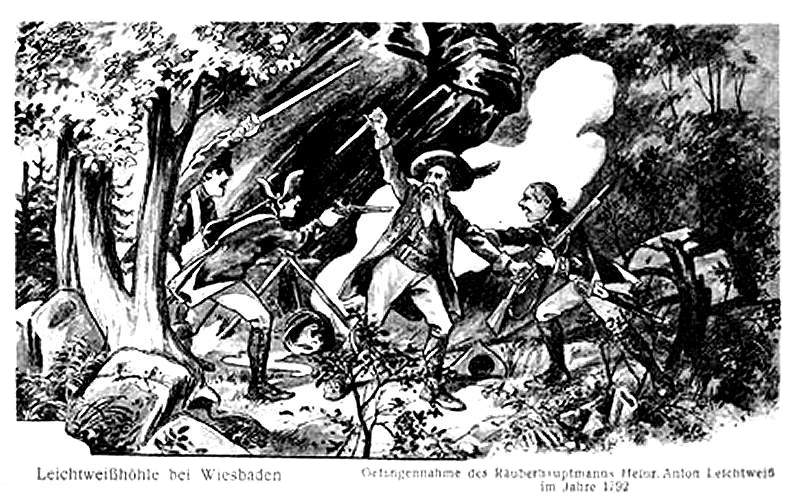
This core of the story seems to be largely documented. However, we have not been able to verify it ourselves. All other claims, such as that Leichtweiß was a robber, are fictitious. The postcards and legends are a result of the exuberant imagination of people in the 18th century, and the need to make a freedom fighter out of him.
1. The ‘Evil Neighbour’ version
The most modern version of the story seems to be the one in which, as a 55-year-old successful innkeeper and baker, he was apparently wrongfully arrested. Presumably on the basis of false accusations made by an enemy he was sentenced to a year in prison on flimsy charges. After a year in prison, he was apparently mentally disturbed or suffering from PTSD and did what many war veterans in the USA do. He could no longer stand his family and so, after his release, did not return home but became a vagrant. In the process, he discovered the cave and lived there. When the authorities rediscovered him there, the mere fact that he was living as a vagrant was enough to lock him up again. There is actually quite a bit to support this version: why would a successful older gentleman turn to crime?
2. The ‘bandit captain’ version
The postcards and legends are a product of the boundless imagination of people in the late 18th and early 19th centuries, and the desire to turn him into a freedom fighter. Countless tales of knights, robbers and romance also emerged during this period; this era is therefore also referred to as German Romanticism.
Literature
- Walter Czysz (1983):
Heinrich Anton Leichtweiß. Ein Bürgerleben im 18. Jahrhundert.
Schriften des Heimat- und Verschönerungsvereins Dotzheim e.V., Nr. 8, 11 S., zahlr. Abb.; Wiesbaden ISBN 3-922604-02-01.
Neuauflage 2006 vom Thorsten Reiß Verlag. ISBN 978-3-928085-37-3, 9,80 €.
 online
- On showcaves.com
 Leichtweißhöhle
 Search DuckDuckGo for "The Story of the Poacher Leichtweiß"
 Station: [4] Bad Boy Leichtweiß (visited: 19-MAR-2021)
 Index
Index Topics
 Hierarchical
 Countries
 Maps
Maps